

LEGACY LAG OVERVIEW
Most organisations still make strategic decisions based on who customers used to be, not who they are now. Legacy Lag is the pattern that emerges when inherited assumptions keep organising decisions long after markets have changed.
It shows up as work that feels “off” even when the numbers look acceptable.
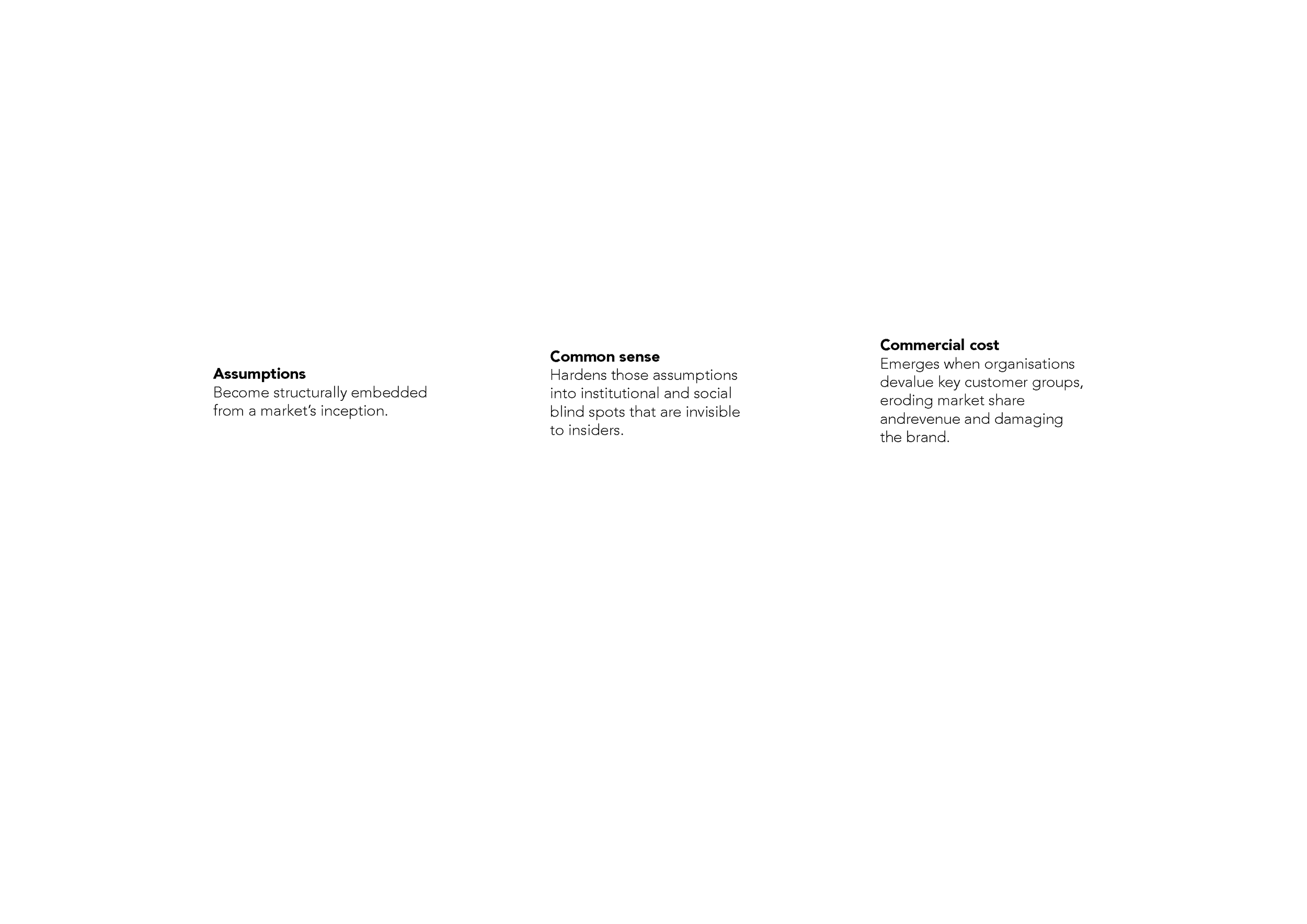
Legacy Lag: Operating Model
Legacy assumptions form under specific historical conditions, get encoded into processes, and eventually harden into “how we do things.” When economic or cultural shifts occur, those assumptions no longer fit.
That creates a gap between the organisation and the market, which only becomes visible at the point of exposure—through lost revenue, legal risk, or brand damage. Legacy Lag Diagnostics is designed to intervene between the shift and the gap, before the crisis hits.
Formation → Encoding → Embedding → Shift → Gap → Exposure
Original conditions → Early logic forms → Becomes “how we do things” → Economic/cultural change → Institution misaligned → Revenue, legal, brand
Legacy Lag diagnostic
The Legacy Lag diagnostic is a structured audit that makes this pattern visible before it turns into failed campaigns, stalled growth or public controversy.
What it diagnoses:
Outdated assumptions in products, messaging and internal processes.
How inherited cultural logic is embedded in briefs, research frameworks and decision‑making.
The commercial and reputational consequences of that misalignment.
What organisations receive:
A clear map of where legacy assumptions are operating.
Evidence of impact on growth, brand equity and customer relationships.
A practical roadmap for updating models, governance and narratives to align with current market reality.
How Legacy Lag shows up
Typical symptoms
Products and services built around outdated customer profiles.
Messaging that feels tone‑deaf or leans on hollow empowerment while ignoring structural reality.
Sponsorships and initiatives that create heat or backlash, but not commercial value.
Women’s work, or women’s sport treated as marginal, despite women’s growing economic power.
WHY IT MATTERS
Why this is a 2020s problem
Women as customers and consumers are a prime example of Legacy Lag. They now control trillions in global spending, influence the majority of consumer decisions, and are inheriting unprecedented wealth.
When organisational assumptions lag behind that reality, brands miss growth, invite reputational risk, and leave open space for competitors who take these customers seriously.
What Parallax Lab does with it
How Legacy Lag is different
What Parallax Lab does
Parallax Lab uses Legacy Lag as a diagnostic lens to trace where inherited assumptions are embedded in your products, processes and narratives, and to turn that into evidence‑based strategy.
WAYS TO WORK
Talks and workshops
Legacy Lag diagnostic audit
Strategy sprints and advisory
If this sounds uncomfortably familiar, start a conversation.
Most diagnostics treat symptoms—flat growth, failed campaigns, reputational flare‑ups. Legacy Lag goes upstream to diagnose the structural assumptions creating those problems, before they surface in the work. It combines cultural theory with commercial evidence, so recommendations land as strategic levers, not as generic diversity advice.